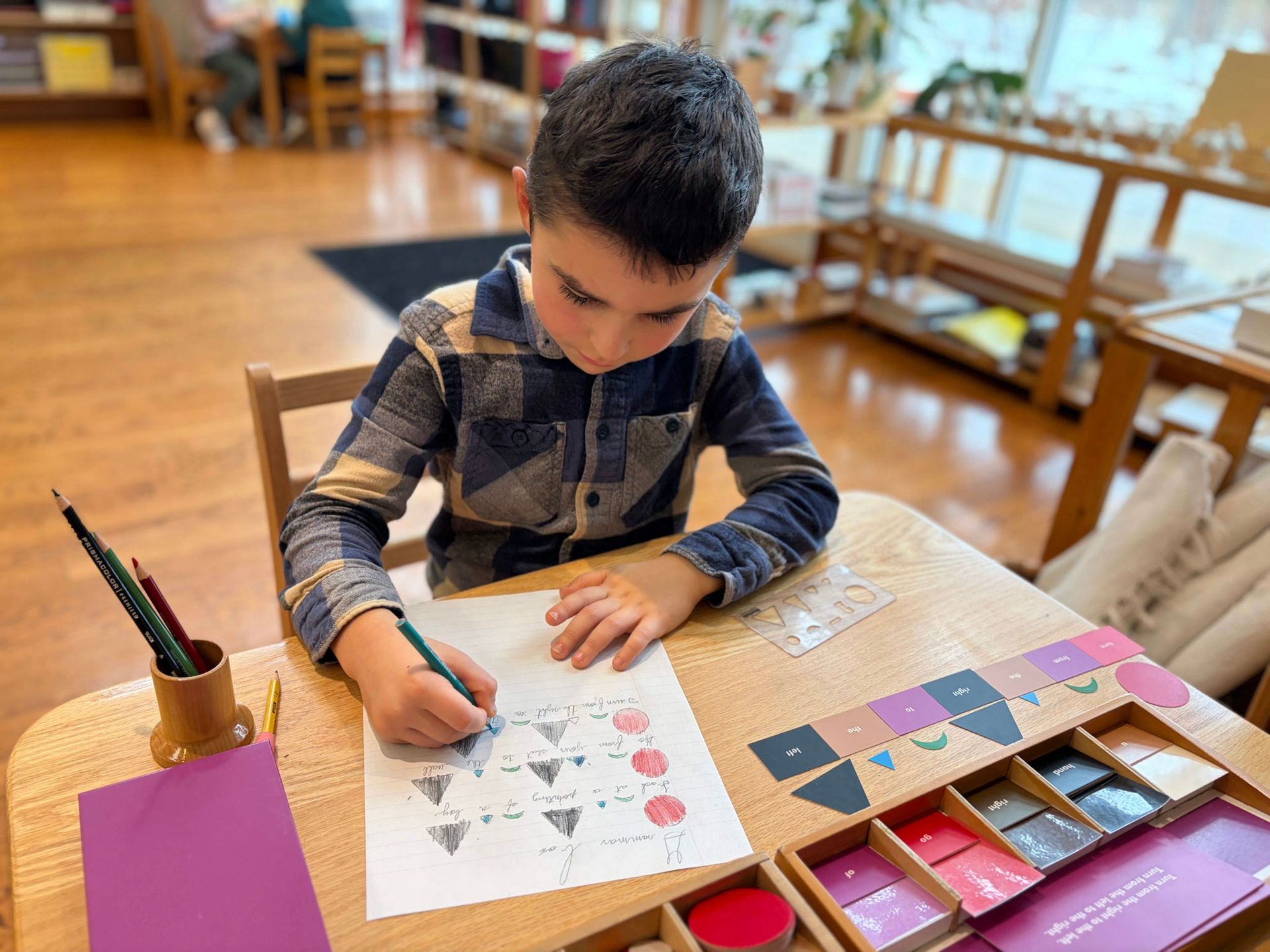
In the Montessori approach, “work” is not a dirty word; it’s a glorious word. For the child’s real “work” is to form their own, unique human being in the world, through everything that they do and everything that they engage in. Think of how you feel when you are fully immersed in something you love to do. It could be polishing your antique car, fly fishing, writing a poem, a speech, solving a math equation, or helping a client. If you have work that absorbs you in such moments, then you understand that inspiring work feels good to children, too. Of course, children do not think of their actions as work, but Montessori proposed that what children do should be respected as their work.
The infant’s task is to build a person, so she is fully engaged in kicking her legs and making sounds, delighting in it, concentrating on it, going on with it even when it takes effort. And here is a main reason that Montessori is so timely for today’s youth: when we have found some piece of work that engages us fully, effort is a friend that helps us persevere. With the Montessori approach, children develop an attitude that effort is a friendly, natural part of any learning process. This is because effort is built in to every activity they engage in at school that leads them into flow.
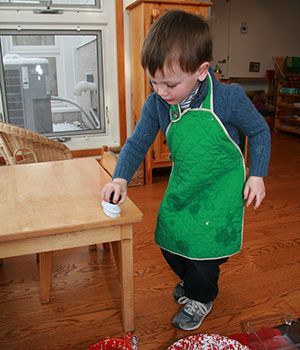
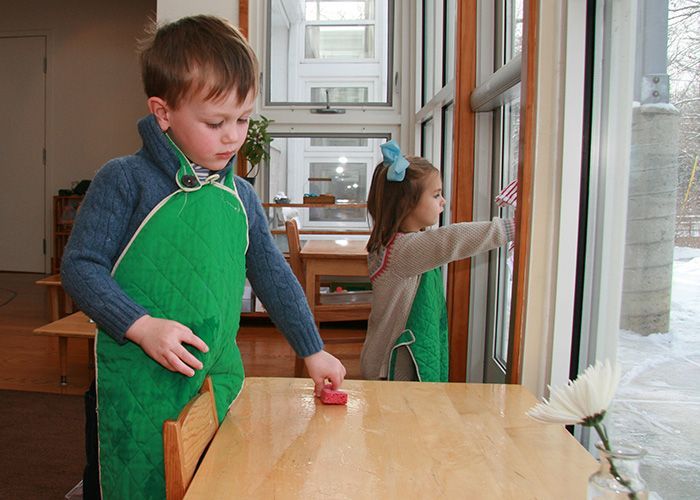
In a Primary Classroom, I watched a four-year-old boy wash a table with such gusto and flourish that he seemed completely unaware of the other children walking past him and talking. He did not seem to hear the bells a child was playing on the far side of the room, the water splashing in the sink as another child filled and refilled his bucket just five feet away, the classroom door opening, a child entering, the door closing again, or a girl tap-tap-tapping her feet while she was counting out loud at a table three feet to his left, adding four digits numbers with a bead frame. All this and more was swirling around him, and he was bent over his work, apron hanging down and wet with water, making big, round motions with his arm as he scrubbed the surface of the wooden table. His long curly bangs were swinging over his brow, the shoelaces of one shoe untied and lying on the floor while he rocked forward and up on the balls of his feet to reach the far side of the table, one hand flat on the table to support his weight.
The boy paused when he had made the soapsuds cover every part of the table surface. He stood upright, took a step back, brushed his dark curls from his face with a wet forearm holding the child-sized scrub brush, glanced up at the child sitting near him, and just as quickly bent over his floor mat to his right with all the table washing materials laid out on it: sponge, soap dish with soap bar in it, a wash-cloth for drying, a tiny bucket half filled with water. He rubbed the scrub brush on the soap bar, stopped and looked at the bristles, re-wetted them in the bucket, and rubbed them on the soap again (quite firmly). When he noticed suds building, he paused again, glanced at the underside of the brush, and went back at it with the table surface. He scrubbed and scrubbed, moving his circular motions around to cover the entire surface again. This repeated and went on for a good 15 minutes.
Beads of sweat formed on his forehead and his hair started to stick. He seemed unaware and unfazed, completely absorbed in his whole body movement. Then he put the brush on the floor mat, squatted down and took the sponge, and started wiping the table in smooth, long swipes from one side to the other, eventually removing most of the suds. He bent over and plunged the sponge into the water bucket, and at that moment another boy came over and said something to him. He smiled up at him, then looked back down and squeezed the sponge out with both hands, and the other boy walked away. He stood straight up, looked after the other boy for a moment, then watched the water dripping into the bucket from his sponge, long, slow drips. He looked pensive, watching…then squeezed the sponge out with more force, watched, then started wiping the table again.
He stopped after a while and sighed, stood up and noticed a girl walking by with a tray of flowers. He then dried his table with the dry wash cloth and quickly cleaned up the things on his mat, returning the water from the bucket into the child-level sink and taking the scrub brush over to the sink and rinsing it with a gushing stream of water (it dripped from his hand the whole way back to his mat but he did not notice this). He squatted down to his mat and put the sponge, dish with soap, and scrub brush back into the little bucket. He then paused and pulled them all out again.
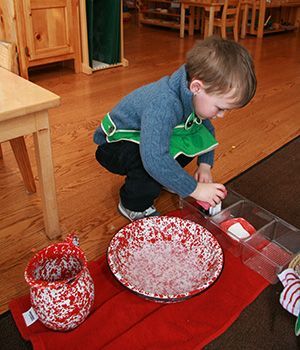
Such episodes repeat throughout the day in a Montessori Primary classroom. This is a prime example of how a child organizes his thoughts and motions with a sequence of actions, integrating his will, decision-making, and body movements—both gross motor and the small motor of his fingers—and exercising care for materials and the environment. The child uses such exercises to satisfy his craving for purposeful work: not of the work of washing a table per se, but the deeper work of building all the cognitive and physical aspects of his personality. Dr. Montessori pointed out that young children need these organizing activities that have real purpose and connection to community life to build themselves through.
The effort and focus that rose out of this determined activity was his alone; a child can measure and respond to the level of effort he or she feels rising in them during the activity and adjust and work with that sensation of effort. It is completely unadulterated and not manipulated or created by an outside force, but comes from within that individual child. So, effort is a different experience than the one we deliver to children when we give them an assignment. Accomplishing specific tasks later when asked to is something our Montessori children can willingly do with confidence because of such numerous experiences they have had of flowing with effort by their own accord.
These simple practical life activities, such as washing, cleaning, and arranging, lay the foundation not only for effort but for the organizing of thoughts as a child experiences sequences of actions and their outcomes in all their stages and orders. Montessori uniquely employs such activities as the building blocks for thinking and doing. They deliberately and precisely set the stage for mathematics, language arts, and all the child’s intellectual and physical work to come. Simultaneously, our children’s healthy approach to effort translates into resilience and perseverance that will distinguish them in their later years.