In Our Struggle, We Can Find Hope
My grandmother, Paula Polk Lillard, has often spoken of the unique challenges of raising our children in affluent times. While it would never be my choice to be in our current situation, I am able to see the wisdom in her observation. As a society, our children have not had to truly sacrifice their own comfort for the greater good. My children have not experienced what it means to defer their own plans and goals for the health and life of others in a direct, immediate, and enduring way. We do not know what the next days or weeks will bring. Certainly, the world will look different when we emerge. Some things will be worse. But we as people do not have to be worse.
In times of crisis, there also exists great opportunity. I am asking myself, Who do I want to be in this crisis? Who do I want to be after this crisis passes? I want to be stronger, gentler, more creative, more humble, more resilient, and more gracious. And I want my children to feel this, too. In Paul’s letter to the Romans he wrote, “Suffering produces endurance, and endurance produces character, and character produces hope, and hope does not disappoint us.” We are alchemists. Our hearts can transform this suffering into character. And if we have character, we have hope. This is a hope for many things: Hope for a loving community, hope for kindness between neighbors, and hope that even if our world is a more challenging place after this passes, it also can be a better place.
Montessori Routines at Home
As I think about my daily life with my children during this indefinite period of isolation, my first priority is to maintain their sense of security and well-being. They can endure much hardship if they continue to feel that our home is a safe and loving place. In this spirit, I am providing a gentle and productive structure to our day.
My children (ages 5, 7, and 9) are fortunate enough to go to a Montessori school. This means that they already know how to work, and they know how to be productive and self-directed. They have an incredible foundation for future academics. They also have three years in their individual classroom environments, which means that there is already flexibility and thoroughness built into their curriculum. Given this knowledge, I am assured that we have at least two months before I need to start thinking about their strict academic development. This frees me up to find a structure for their day that puts their work ethic and creativity at the forefront.
My goal for this period of time is to create an environment that encourages self-direction, concentration, and the cycle of an activity. If I can keep these elements of their Montessori experience alive, then I know that my children will have the capability of picking up where they left off academically when they enter the classroom again. Children love to choose, to work, and to complete their projects. We see this over and over again in the Montessori classroom. So, now I need to prepare my home environment to protect this: Self-direction, concentration, and the cycle of an activity.
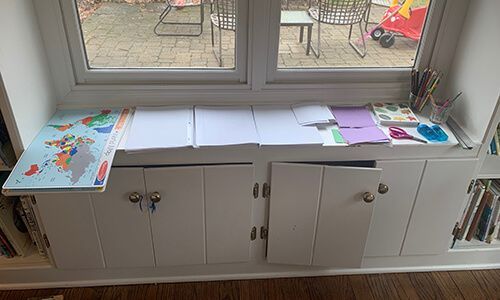
This weekend, we had a family meeting. We told the children that every weekday morning from 8:30-11:30 would be “Home School.” We set up a shelf with supplies—graph paper, plain paper, lined paper, pencil sharpener, colored pencils, writing pencils, and scissors. They picked out journals so they can record their work choices during the morning. I told them that they can make any productive choice of work during the morning that includes a work cycle—something they choose, do with minimal help, and then clean up on their own. This includes puzzles, drawing, collecting leaves, baking, building, and other home activities. They can do any piece of work for as long as they want, but they need to put it away before getting out something new. They can work on their own, they can work together cooperatively, or they can observe what another sibling is doing, but they need to be respectful and quiet, just like they already are at school. At 11:30, we will clean up the work space just like they do at school—sweeping, putting away bits of paper, straightening materials, and pushing in chairs. Then we will make lunch, and our afternoons are for reading, being outside, and playing, which will include at least an hour of being quiet and independent so that I can maintain some degree of my own work, exercise, and relaxation routine.
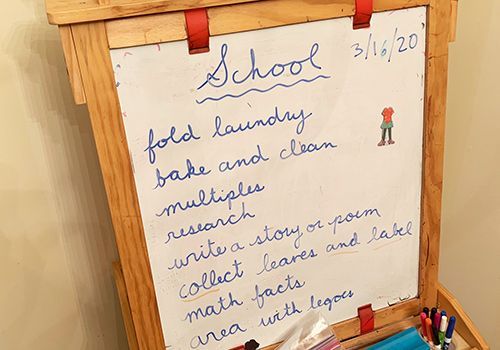
The night before our first day, I wrote a list on our white board with just a few ideas. These ideas are not meant to be exhaustive, nor are they required. It is not my job to tell them what to do. In fact, that would interfere with their developing self-direction. These ideas are on the board for now, simply to connect my children to our home as an educational space. They are an inspiration meant to remind them of all the educational work that is available to them here even though they are not at school. I anticipate that during the next few days, I will swap out a few ideas and add new ones, to keep them thinking about what we can do at home. By the end of the week, we probably will no longer need this prop, but, depending on how long this period of isolation lasts, we may need another brainstorming session of ideas for work we can do at home!
I am writing this in the midst of our first morning. So far, my children have chosen leaf-collecting (which includes etching and labeling), puzzles, reading, a sand and cornstarch experiment that my seven-year-old found in a science book, building a robot with simple electronics, and making a booklet with names of animals and pictures. Every time they have come to me for unnecessary help, or have been loud or distracting, or have started to use a whiny voice with me, I remind them in my “teacher voice” that this is school, and that I know they would not do that at school. We have had this interaction plenty of times, but they always know what I mean! My sense of humility fully acknowledges that this is day one, and that the novelty will certainly wear off. But I am grateful for the way that they are rising to this occasion today.
I am also utilizing this period of time for an emphasis on chores and helpfulness. With no other pressures or time constraints, I can be assured that my children have both time and energy for doing work around the house. They can fully clean up after themselves, and they can help with the running of our household. I do not need to create an artificial urge to do chores. I genuinely will need their help for dishes, laundry, sweeping, food preparation, and other areas of care for our environment. This authentic need creates a spirit of collaboration and gratitude.
This evening, we will use this opportunity for family time. Amidst anxiety and turmoil, we have just been gifted that which matters most—unhurried time with the people who are most precious to us in the world. We have time for games, for reading together, and for conversations and questions that we have not always had time to finish. This time is an opportunity to support the transformation in my own children’s hearts. How can my words, attitude, and attention transform this new kind of suffering into their character? How can the stories that my husband and I tell, the love that we show for them and others, and the way we choose to treat and speak to each other transform suffering into character?
We do not know what the next few weeks and months have in store for us. We are prepared for it to get worse before it gets better. We are resolved to be a witness to the world’s suffering, and to sacrifice what we must in order to contribute to the well-being of others. Let us be alchemists. Let us keep turning towards goodness. Let us spread kindness, character, and compassion. And let the world fill with hope.