Is it Work?
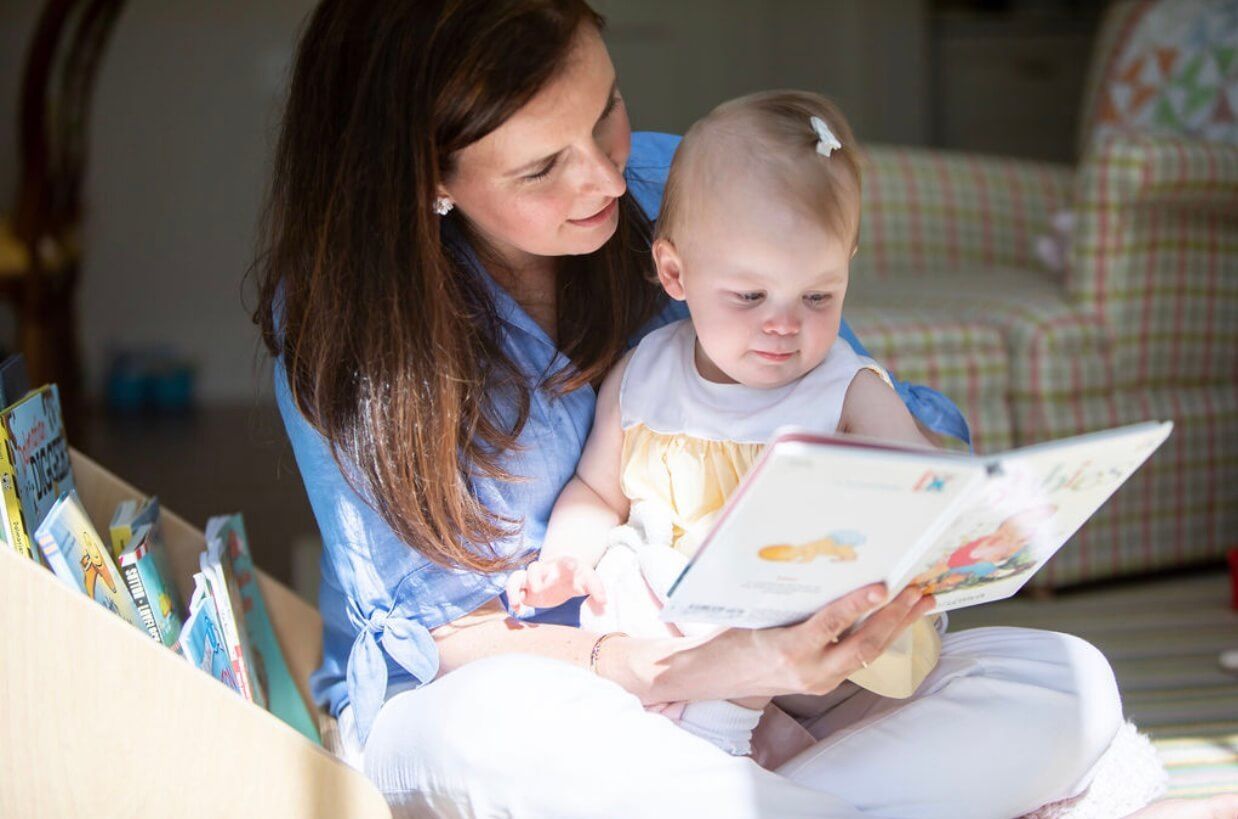
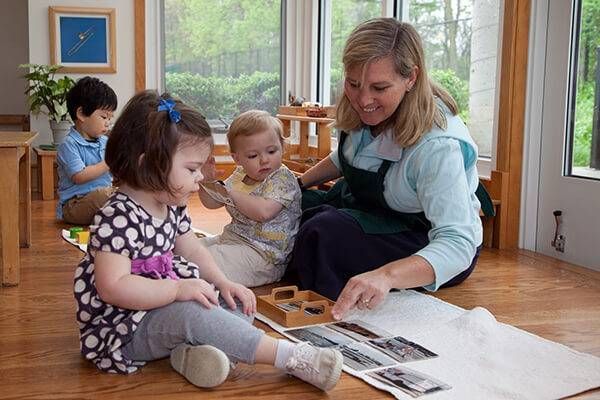
As a parent, you may hear Montessori teachers describe your children’s activities as “work.” Your child may use the word, too, saying, “I love my work,” or, “I did a lot of work today!” But then you may wonder, “Why does my child go skipping in there every day?” and, “Why is my child dying to get back to school after the vacation, and sad when school is canceled?” How can “work” be so much fun?
Quite simply, Maria Montessori discovered that working at something that interests them is playful for children, under the right conditions. It must be internally inspired with choice offered for freedom. Montessori found specific ways for children to meet their developmental characteristics and needs through purposeful activities. A kind of joy arises when children can fulfill their natural drive to form their personalities and improve their abilities. In other words, children love to play games that have internal purpose for them.
Let's Play a Game!
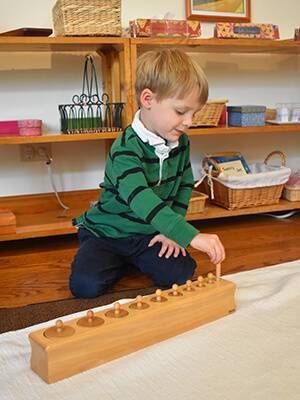
One of the most enjoyable things about being a Montessori teacher is that it doesn’t feel like “work” for the adults, either, because we get to say “Let’s play a game” all the time. Have you ever noticed that in Montessori, learning to count, add and subtract with the bead bars is called The Snake Game? Or that to practice a moment of quiet meditation is called The Silence Game? Montessori’s introductory exercise for learning to read is called The Sound Game, and the first time a child writes long multiplication on paper it’s called The Dot Game.
Dr. Montessori appealed to children’s playfulness by making learning activities into games. The wording invites children to approach activities with curiosity and inquisitiveness. It invites them to explore, quite literally with their hands and senses, and also abstractly, with their minds. But importantly, Dr. Montessori also recognized that children want to do real things. She gave young children respect by offering realistic, purposeful learning actions for them to learn through. Even today, young children desire this respect: In her research, Dr. Lillard has found that children as young as 4-6 years old prefer real activities to pretend ones. If given a choice between preparing pretend food with a pretend knife and preparing real fruit with real utensils for sharing with others, children often prefer the latter.[1] This may be because they delight in being able to do things that they see grown ups do.
Perhaps children know, unconsciously, that these are things that will develop their independence and further their self-mastery in the world.
Playfulness in Childhood
Before she became interested in Montessori education, Angeline Lillard was a researcher who focused on children’s pretend play. She is now an internationally leading researcher on both play and Montessori, separately. But the two topics, interestingly, are intricately related. Dr. Lillard explains that by making real activities game-like, Maria Montessori succeeded to collapse the tension between work and play, structure and freedom.[2] This is why your children skip into Montessori schools, enthusiastic about doing their “work.”
Children have a tendency to play and to be playful. They also enjoy challenging themselves to acquire new abilities. In response, Montessori teachers invite their children to self-challenge their memory, their balance, their hand-eye coordination, and their self-control in many ways all throughout the day. Some of these games are quite hard to do, like memorizing a 4-digit number and keeping it in your head while walking across the room, then collecting the correct number of unit beads, ten bars, hundred squares and thousand cubes to represent that same number, and bringing it back to the teacher all by yourself! Or closing your eyes and feeling objects inside a bag with your hands and describing them out loud. In such activities, the children feel that they are playing games—and they are—but more importantly, the enjoyment deepens their engagement with their activities, and they learn difficult concepts and develop important abilities for further learning.
The aspect of playfulness invites children to focus on and to delight in the sensation of self-challenge. As they find this state over and over in their daily experiences in the classroom, children become insatiable learners with wide interests. This long-term effect seems to be the primary reason adult graduates report feeling that early Montessori education greatly benefitted them.
Be Playful at Home
In these long winter months when your family is often indoors, parents can find some simple ways to invite playfulness into your own lives. To be playful, your first instinct may be to get a competition going because that is the way that many of us learned to play games as children. “I’ll race you to the car” or “Let’s see who can…”. But that isn’t the kind of playfulness that leads to learning, independence and self-assuredness. So, pause and think first about what elements make an activity playful, vs. a competition, between two individuals.
You can begin by asking, “I wonder…”
I wonder if this hat can fit into this bag…
I wonder if the water is too hot, too cold, or just right…
I wonder where your snow boots are now…
I wonder if you can make this room neat and tidy before bedtime…
I wonder if you can reach that…
I wonder if you can help your sister…
Each question can feel like a spontaneous game for your children.
You can demonstrate challenging yourself, too, by saying, “I’m going to see if I can…”
I’m going to see if I can put this bicycle behind the others without tipping them over…
I’m going to see if I can make this door close without a sound…
I’m going to see if I can balance this cup on the tray without spilling all the way to the table…
These questions may inspire your children to also challenge themselves in fun ways.
When you look at a photograph or a book illustration, try a Where’s Waldo? approach.
I’m looking for a snowflake in the photo. Do you see one?
I’m trying to decide if that person is happy or sad. What do you think?
I’m searching for something red in this painting. Do you notice anything red?
Asking such questions invite interaction and conversation. And it’s fun!
We tend to think of “quizzing” or “testing” a child when asking them questions. But in Montessori, we take a more friendly approach of challenging ourselves alongside one another. The adult models challenging him or herself, while encouraging the child to challenge him or herself in their own ways. This result is children who enjoy challenge and who set ambitious goals for themselves because nothing is imposed on them—it is self-driven. This approach supports children to develop courage and realistic confidence.
What Kinds of Games?
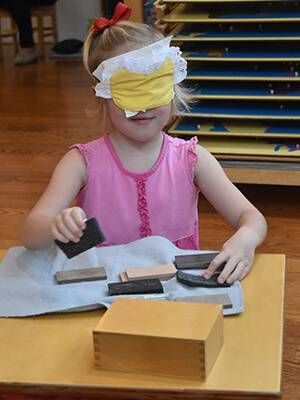
Younger children are fascinated by exploring with their senses. They love to listen for sounds, search for tiny visual details, touch things with their hands and learn the names of degrees of variability. (This is smooth, this is rough, this is tepid, this is cool, this is sour, this is sweet. This is heavy, this is heavier, this is long, this is longer). You can make up a playful little game on the spot wherever you are, any time, by demonstrating how we can use our senses to learn about our surroundings.
Young children also love to play memory games. Turn over several photographs or cards with images and play a spontaneous game of memory. Which one was the black dog? Which one was the brown cow? Or listen to bird call recordings and see if you can remember which bird makes which call. Just compare 3-4 at a time, and keep it simple.
Older children, ages six to twelve, enjoy exploring with their minds more than their senses. They love tongue twisters and finding facts. This is when board games become fun for them. But you can also make up spontaneous games wherever you are, like trying to list the U.S. presidents in order, or seeing how many state capitols family members can recall.
Elementary aged children also love to make up their own games, complete with rules, and play them with friends. These can involve math facts, historical figures or building complex structures with blocks or Legos.
Adolescents tend to enjoy trivia games and cards games, like poker. They love to trump the adults with what they know and with what they can do.
Learning Can Be Fun
Being playful can break up the tedium of a long day or a task you’d rather not do. Ironically, when the playfulness deepens the meaning of an activity, rather than distracting from its purpose, it is more engaging for children, not less. Think of the story of Tom Sawyer with painting the fence. The idea is not to make the painting activity into a “paint war” of throwing paint all over the yard. Instead, the playfulness gets added into the purpose (of painting the fence, for instance) and having a finished product at the end.
Children do love to learn. Many of us associate learning and learning in school, in particular, as being drudgery. But that is not because of the information presented. Rather, it was the methods of teaching that burdened many of us as young students. Using strategies like intimidation, rewards and punishments, prodding and competition, have made learning in conventional schools into unpleasant chores for many individuals. But in Montessori, where learning is presented in playful and enjoyable exercises, children learn for pure pleasure. This is just another example of where Montessori has been designed so that the education matches children’s natural characteristics and needs. It fits to the children’ natures, rather than forcing them to match an arbitrary education model designed by adults who aren’t considering how children really learn.
Now you know that when your children skip into school in the morning to work with the Montessori materials, to challenge themselves in some new ways, to learn new skills or to create a big project or a research report, it’s because they feel engaged and inspired by an atmosphere alive with playfulness!
To read another of our blog articles about play, see Playtime is Not Wasted Time
To learn more about her research, read Dr. Angeline Lillard’s numerous papers about children and play
Additional Reading
[1] A.S. Lillard and J. Taggart, Children prefer the real thing to pretending, Sciencebreaker, March 2018.
[2] Angeline Lillard. Montessori, an alternative early childhood education. Early Child Development and Care, vol. 191, 2021.